Transmission
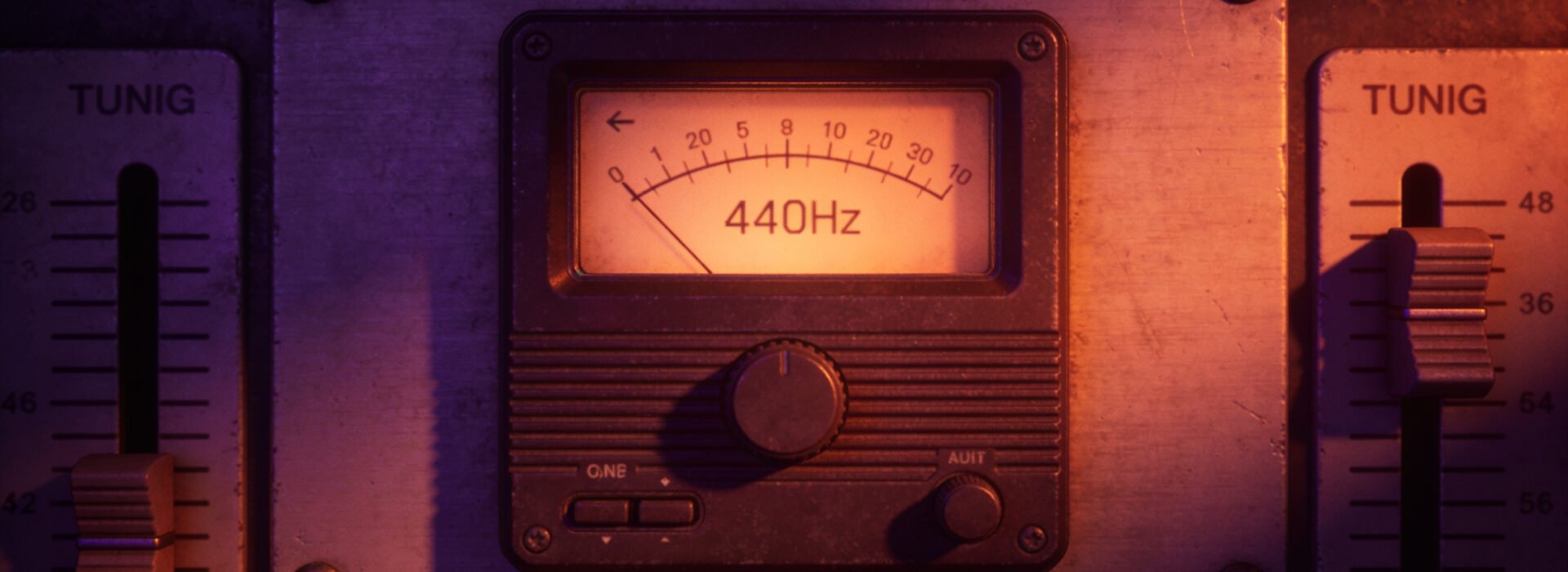
432 vs 440: The Real Story
Somewhere on the internet, someone is insisting that 440 Hz is a Nazi mind control frequency designed to make you anxious and disconnected from nature. Somewhere else, a session musician is rolling their eyes so hard they risk a medical incident. Both of these people are missing something true.
The debate over concert pitch — whether instruments should tune to A=440 Hz or A=432 Hz — is one of those rare arguments that manages to be simultaneously overblown and genuinely interesting. Strip away the conspiracy scaffolding and there’s a real historical story, a legitimate psychoacoustic question, and a practical consideration that working musicians have been quietly navigating for centuries.
What Concert Pitch Actually Is
Before anything else, it’s worth being precise about what we’re talking about. Concert pitch is the agreed frequency for A above middle C — the reference point from which all other notes in equal temperament are calculated. When an orchestra tunes before a performance, the oboe plays that A, and everyone adjusts to it. The number attached to that A is what the entire debate orbits around.
The reason a standard needed to exist at all is that, for most of Western music history, it didn’t. Pitch varied wildly between regions, between instrument makers, between decades. A Baroque organ in Hamburg might tune its A significantly higher or lower than one in Paris. When orchestras from different cities performed together, instruments often simply couldn’t play together without one of them compromising. This wasn’t an abstract problem — it caused genuine practical chaos.
The historical record shows A wandering between roughly 400 Hz and 480 Hz across the 17th through 19th centuries. Some Baroque pitch conventions sat around A=415, which is almost exactly a semitone below modern 440. This matters for a reason we’ll return to.
The Paris Conference and the Road to 440
The push toward standardization gathered real momentum in the 19th century, partly because instrument manufacturing was industrializing. If you were making thousands of clarinets, you needed to know what pitch they’d be playing at.
In 1858, a French government commission — which included the composer Giacomo Meyerbeer and physicist Jules Lissajous — recommended A=435 Hz. France adopted this as its official standard. Other countries followed loosely, though with the usual European reluctance to agree on anything fully.
Giuseppe Verdi enters the picture here, and his involvement is often cited by 432 advocates as a kind of endorsement. The story is real, though the conclusion drawn from it is murkier. Verdi did write to the Italian Music Commission in 1884 arguing for A=432, complaining that orchestras were creeping upward in pitch — a genuine trend driven partly by the perception that brighter, higher-strung instruments projected better in large halls. He wanted to anchor pitch lower to protect singers’ voices. Verdi’s concern was practical and vocal, not metaphysical.
The modern standard of A=440 was agreed at an international conference in London in 1939, adopted by the International Organization for Standardization in 1955, and reconfirmed in 1975. It was a pragmatic international compromise, particularly useful for broadcasting, recording, and the manufacturing of electronic tuning equipment.
Which brings us to the Nazis.
The Conspiracy Theory, Examined
The claim circulating widely online is that the Nazis — specifically Joseph Goebbels — pushed for A=440 as a means of psychological manipulation, that the frequency creates disharmony and anxiety in the human body, and that 432 Hz is the “natural” frequency aligned with the universe, the Earth’s Schumann resonance, and various sacred geometries.
The historical claim falls apart quickly. The 1939 London conference was convened by the British Standards Institution and attended by representatives from multiple countries, including the United States. Germany, under Nazi rule at the time, was actually absent from many international standards bodies by 1939. The idea that Goebbels engineered the adoption of 440 Hz has no documentary support and contradicts the institutional record of who was actually in the room.
The scientific claims require more careful handling, because dismissing them entirely would be its own form of sloppiness.
The Schumann resonances are real — they’re electromagnetic resonances in the cavity between Earth’s surface and the ionosphere, with a fundamental frequency around 7.83 Hz. They have nothing to do with musical pitch in any physically meaningful way. The claim that 432 Hz “resonates with” this frequency involves arithmetic that doesn’t hold up: dividing 432 by successive powers of 2 eventually gets you to 1.6875 Hz, not 7.83. The connection is numerological, not physical.
As for peer-reviewed research demonstrating health or psychological benefits from 432 Hz over 440 Hz — it is essentially nonexistent at any methodologically rigorous level. A handful of small studies have appeared, mostly in complementary medicine contexts, with sample sizes and controls that prevent any meaningful conclusions. The mechanism proposed — that cells or DNA “vibrate” in response to ambient musical pitch — doesn’t correspond to how cells or DNA actually work.
What the Ear Actually Hears
Here is where it gets genuinely interesting, and where the 432 advocates are, despite everything, pointing at something real.
The difference between 432 and 440 Hz is approximately 32 cents — roughly a third of a semitone. This is not inaudible. Most musicians with decent ears can hear the difference between two pitches 32 cents apart when played simultaneously as a beating interval. Whether they can reliably identify which of two isolated pitches is “the 440 one” in a blind test is a different, much harder question — and the evidence suggests most people cannot.
But pitch has real perceptual character. Music played in A=432 is, objectively, slightly lower in overall pitch than the same music in A=440. Lower pitch tends to be perceived as warmer, darker, more relaxed — not because of any mystical property, but because of basic psychoacoustics and learned cultural associations. Higher pitch registers as brighter, sometimes more urgent. This is not pseudoscience. It’s the same reason a cellist and a violinist playing the same note sound different, and why a brass band sounds different from a string quartet playing in the same key.
Some musicians who work in 432 Hz report that their instruments feel more resonant, easier to play, less strident. Some of this is surely placebo, but some of it may be genuine — slightly reduced string tension does affect how an instrument responds under the fingers, and acoustic instruments have resonant properties that interact with pitch in complex ways.
What the 432 advocates are describing, when they describe music that feels more “open” or “natural,” is a real perceptual experience. Where they go wrong is in assuming that experience requires a cosmic explanation, or that 440 Hz was designed to deprive them of it.
Historical Pitch and What It Tells Us
The historically informed performance movement — ensembles playing Bach, Handel, Monteverdi, and their contemporaries on period instruments at period pitch — has been doing something like this for decades, without any of the metaphysical baggage.
Baroque pitch at A=415 is a well-established convention in this world. It sounds different from modern pitch. Recordings by conductors like René Jacobs, Philippe Herreweghe, or William Christie in that register have a particular quality — an intimacy, a slightly different relationship between the instruments — that their admirers find deeply satisfying. Nobody is claiming that 415 Hz aligns with the golden ratio or protects your DNA. They’re just acknowledging that pitch has character, and that character changes with context.
This is the most honest version of the 432 argument: not that 440 is a conspiracy, but that pitch is a choice, and different choices produce different aesthetic results. That’s true. It’s also completely uncontroversial among musicians who have thought carefully about it.
What Musicians Should Actually Do With This
If you record acoustic music and you want a slightly warmer, darker, more intimate sound, there’s nothing stopping you from tuning down. Some artists have done exactly this — recordings exist that were deliberately tracked at 432 Hz or various other non-standard pitches because the artist preferred how it sounded. This is a legitimate aesthetic decision, the same category of decision as choosing a particular microphone or room.
If you’re playing with other musicians, using samples, or working in any professional context where pitch compatibility matters, then 440 Hz is the sensible default — not because it’s cosmically superior, but because standards exist to enable collaboration, and this is the one we have.
If you play a fixed-pitch instrument — piano, fretted guitar, vibraphone — retuning for 432 Hz means physically adjusting the instrument or using software pitch-shifting, which introduces its own colorations. The practical cost may outweigh the aesthetic benefit for most people.
The deeper lesson, and the one that the entire debate inadvertently teaches, is that we treat A=440 as a law of nature when it’s actually a convention. Conventions are useful. They’re also contingent, historical, revisable. The note you tune to is a choice, even when you make it automatically, out of habit, because that’s what the tuner app says.
Verdi understood this. He didn’t think 432 Hz was sacred. He thought orchestras were getting too bright and singers were straining. He wanted to make a different choice. That’s all the argument needs to be — and it’s more interesting, more grounded, and ultimately more useful than anything the conspiracy version has to offer.
Pitch is not a fact about the universe. It’s an agreement between people. What you do with that knowledge is up to you.
Explore different tuning references and hear the difference for yourself with the Resonillator Tuning Reference module.
Resonillator is free and always will be. If this was useful, consider supporting on Patreon or Buy Me a Coffee.
← All Transmissions