Transmission
Writing in the Dark
You’ve been staring at the page for an hour. Nothing comes. The harder you concentrate, the emptier your mind gets. You try a different chord. You rewrite the same line for the fifth time. You make a cup of tea, come back, and the page is still blank. The session is a failure. You close the notebook and go to bed.
At three in the morning, you wake up with the entire chorus in your head.
This experience is so common among songwriters that it’s become a cliché of its own — the idea that “arrives in the shower,” the melody that “came to me in a dream,” the lyric that “wrote itself while I was driving.” Musicians talk about these moments as if they’re mysterious visitations, gifts from a muse, bolts from the blue. But they’re not mysterious at all. They’re the predictable result of a specific neurological process, and understanding that process changes how you approach the act of writing.
Two Networks
The human brain operates two large-scale networks that are relevant to creativity, and they don’t work at the same time. When one is active, the other quiets down. Understanding which one does what — and when each one takes the lead — is the key to understanding why your best ideas arrive when you stop trying to have them.
The first is the task-positive network, sometimes called the executive control network. This is the network that activates when you sit down to write. It handles focused attention, logical reasoning, critical evaluation, rule-following, and deliberate manipulation of information. When you’re trying to find a word that rhymes with “distance” and has two syllables, that’s the task-positive network. When you’re evaluating whether a line is good enough, that’s the task-positive network too.
The second is the default mode network. This is the network that activates when you’re not focusing on anything in particular — when you’re daydreaming, showering, walking without a destination, lying in bed before sleep. It was originally considered the brain’s idle mode, the neurological equivalent of a screensaver. But research over the past two decades has revealed that the default mode network is anything but idle. It’s doing some of the most complex processing the brain is capable of.
The default mode network specialises in making connections between seemingly unrelated concepts. It draws on autobiographical memory, runs simulations of possible futures, and combines fragments of experience in novel ways. It doesn’t follow rules. It doesn’t evaluate whether something is correct or appropriate or commercially viable. It just connects, endlessly, in patterns that the task-positive network would never allow because they don’t follow logical steps.
This is the network that produces the three-in-the-morning chorus.
Why Trying Fails
When you sit at your desk and try to write, you’re activating the task-positive network. This is useful for some aspects of songwriting — finding rhymes, checking metre, structuring a verse, editing a draft. But the task-positive network is specifically designed to reject unusual connections. Its job is to evaluate, filter and refine. It asks “does this make sense?” and “is this good?” — questions that are essential for finishing a song but lethal for starting one.
The moment you apply critical judgment to an idea that hasn’t fully formed, you kill it. Not because the judgment is wrong, but because the idea needed more time in the default mode network before it was ready for evaluation. It’s like pulling a photograph out of developing fluid too early — the image was forming, but you exposed it to light before it could resolve.
This is what happens during the blank-page hour. You’re running the wrong network for the job. The task-positive network is hunting for ideas, but idea generation isn’t its function. It’s searching with a flashlight in a room where the interesting things are only visible in the dark.
When you give up and go to bed, the task-positive network shuts down and the default mode network takes over. Suddenly the fragments you’d been fighting with — that chord change you liked, the phrase from a conversation last week, the feeling you had walking home in the rain — begin to connect without supervision. No evaluation, no filtering, no “is this good enough?” The network just plays, the way a child plays, combining things for the pleasure of combination rather than the purpose of result.
And sometimes, what it produces is a chorus.
The Productive Walk
Writers throughout history have known this intuitively. Beethoven walked for hours every afternoon and carried manuscript paper because he knew ideas would arrive mid-stride. Tchaikovsky walked for exactly two hours every day — he believed that cutting the walk short by even five minutes would compromise the work. Darwin did his thinking on a gravel path behind his house that he called the Sandwalk, pacing it so regularly that he counted his laps with a pile of stones. Dickens walked twenty miles at a stretch through London at night.
None of them were exercising. They were activating the default mode network.
Walking is ideal for this because it occupies the body just enough to prevent the task-positive network from engaging, but not so much that it demands attention. You don’t have to think about walking. The route doesn’t matter. The pace doesn’t matter. What matters is that your conscious mind has nothing to latch onto, leaving the default mode network free to do its work underground.
Showering works for the same reason. Driving a familiar route works. Washing dishes works. Any activity that is physical, repetitive, and requires zero cognitive engagement will do. The activity is not the point. The disengagement is the point.
Building the Fuel
The default mode network doesn’t create from nothing. It connects fragments that already exist in your memory and experience. This means the quality of what it produces depends on the quality of what you’ve fed it.
A songwriter who reads widely, listens to unfamiliar music, has conversations with interesting people, travels, watches, and pays attention to the texture of daily life is building a vast library of fragments for the default mode network to draw on. A songwriter who listens only to music in their own genre, reads only about music, and socialises only with other musicians is giving the network a limited palette. The connections it produces will be predictable because the inputs were predictable.
This is why Bowie read so voraciously. Why Joni Mitchell painted. Why Paul Simon travelled to South Africa and Brazil. Why Björk studies biology and geology. They weren’t being eccentric. They were feeding the machine — stocking the library with fragments that would collide in unexpected ways when the default mode network went to work.
The practical implication is counterintuitive: the best preparation for writing is not writing. It’s living. It’s reading a novel that has nothing to do with music. It’s watching a documentary about deep-sea creatures. It’s having a conversation with someone whose world is completely different from yours. Every experience, no matter how unrelated it seems to songwriting, becomes raw material for the default mode network. You won’t know which fragment matters until it surfaces in a lyric three months later.
The Two-Phase Method
Understanding the two networks suggests a practical approach to songwriting that many experienced writers have arrived at instinctively:
Phase one: generate. Write without judgment. Use a timer — five minutes, ten minutes, twenty. Don’t stop, don’t edit, don’t reread what you’ve written. The goal is to keep the task-positive network from engaging by giving your hands something to do while your default mode network feeds material up to the surface. Most of what you write will be unusable. That’s correct. You’re not writing — you’re mining.
Phase two: edit. Come back later — hours later, ideally a day later — and read what you generated with your task-positive network fully engaged. Now is the time for judgment, evaluation, and craft. Find the line that works. Find the phrase that surprises you. Find the word you didn’t know you knew. Build from those fragments.
The mistake most writers make is trying to do both phases simultaneously — generating and evaluating in the same moment. This creates the paralysing feedback loop of the blank page: you have an idea, you immediately judge it, the judgment kills it, and you’re back to nothing.
Separating the phases solves the problem because each phase uses the right network for the job. Generation is a default-mode activity — associative, uncritical, playful. Editing is a task-positive activity — analytical, evaluative, precise. Neither network can do the other’s job well. Asking them to work simultaneously is like asking your left hand and right hand to write different words at the same time.
The Dark Room
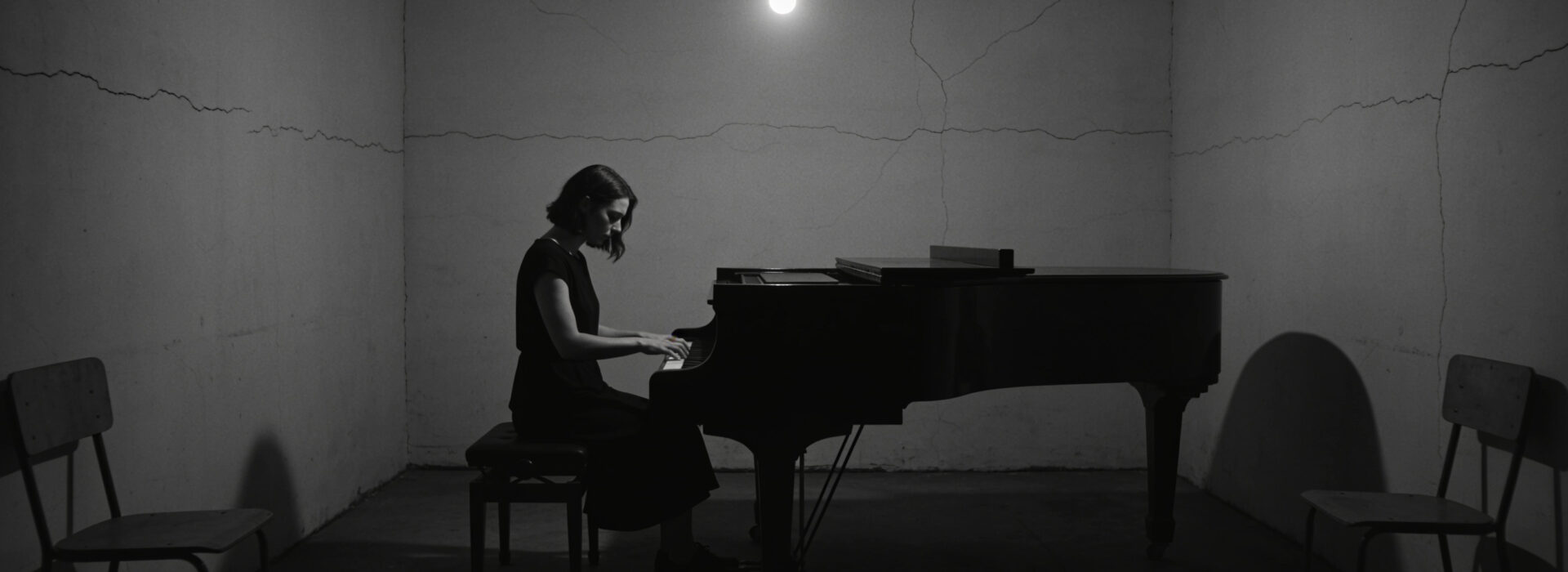
The title of this piece is literal. Writing in the dark — metaphorically, without seeing clearly what you’re doing, without the harsh light of evaluation — is where the most original material comes from. The dark is the default mode network’s domain. It’s where connections form that you couldn’t have planned, where fragments of your experience combine in ways your conscious mind would have rejected.
The light comes later. Editing, shaping, crafting, polishing — these are daylight activities. They’re essential. A song that’s all dark-room material and no editing is self-indulgent nonsense. But a song that’s all editing and no dark-room material is competent emptiness — technically correct and emotionally vacant.
The songwriters whose work endures are the ones who learned to move between the two. To sit in the dark long enough for something to form, and then to bring it into the light carefully enough that the exposure doesn’t destroy what the darkness produced.
The three-in-the-morning chorus wasn’t a gift. It was something you built — slowly, in the dark, with fragments you’d been collecting for years. You just weren’t looking when it finished assembling itself.
Set a timer and write without stopping or editing — the Writing Sprint module gives you a prompt and counts the words. Or find a starting point with Songwriting Prompts.
Resonillator is free and always will be. If this was useful, consider supporting on Patreon or Buy Me a Coffee.
← All Transmissions